

Key Takeaways
- Cooling towers are usually grouped three ways: by build material (FRP, RCC, pultruded FRP), by airflow method (natural draft vs mechanical draft), and by water-to-air flow direction (counterflow vs crossflow).
- The right choice depends on your heat load, available footprint, water quality, and how much ongoing maintenance your plant can realistically support.
- Mechanical draft counterflow towers, like those built on FRP, tend to deliver the most consistent cooling performance in a compact footprint.
- Thermal power plants and data centers rely on cooling towers to reject waste heat continuously, so reliability and water efficiency matter more than upfront cost alone.
Ask ten engineers to name the three types of cooling towers and you’ll get three different answers. That’s not confusion, it’s because “type” depends on what you’re classifying by. One person means the material. Another means how air moves through the tower. A third means the direction water and air cross each other. All three are valid, and all three matter when you’re specifying a tower for an actual plant. This guide walks through each classification so you can match the right types of cooling towers to your process, your site, and your budget.
Why types of cooling towers matters before you specify anything
A cooling tower does one job: it rejects waste heat from your process water into the atmosphere by evaporating a small fraction of that water. Simple in principle. The complication is that a cement plant, a pharma clean room, and a thermal power station all have wildly different heat loads, water chemistry, and space constraints. Picking the wrong configuration means you either overpay for capacity you don’t use or you starve your process of cooling when ambient conditions turn against you.
So before comparing models, it helps to understand that cooling tower types are sorted along three separate axes. Material tells you about durability and maintenance. Airflow tells you about energy use and reliability. Flow direction tells you about thermal efficiency and footprint. A single tower sits on all three axes at once. An FRP, mechanical draft, counterflow tower is a perfectly normal and very common combination.
The 3 types of cooling towers, sorted by how you classify them
Here’s where the “three types” framing gets practical. Depending on which axis you care about most for a given project, the grouping shifts.
By construction material, the three options most Indian plants weigh are FRP, RCC, and pultruded FRP. FRP (fibre reinforced plastic) towers resist corrosion naturally, which makes them a strong fit for chemical, textile, and coastal installations where water and air are aggressive. RCC (reinforced cement concrete) towers are built for very large, long-life installations such as power stations, where the civil structure itself becomes part of the plant for decades. Pultruded FRP uses a continuous moulding process to produce structural members with consistent cross-sections and higher load-bearing strength, bridging the gap between the two.
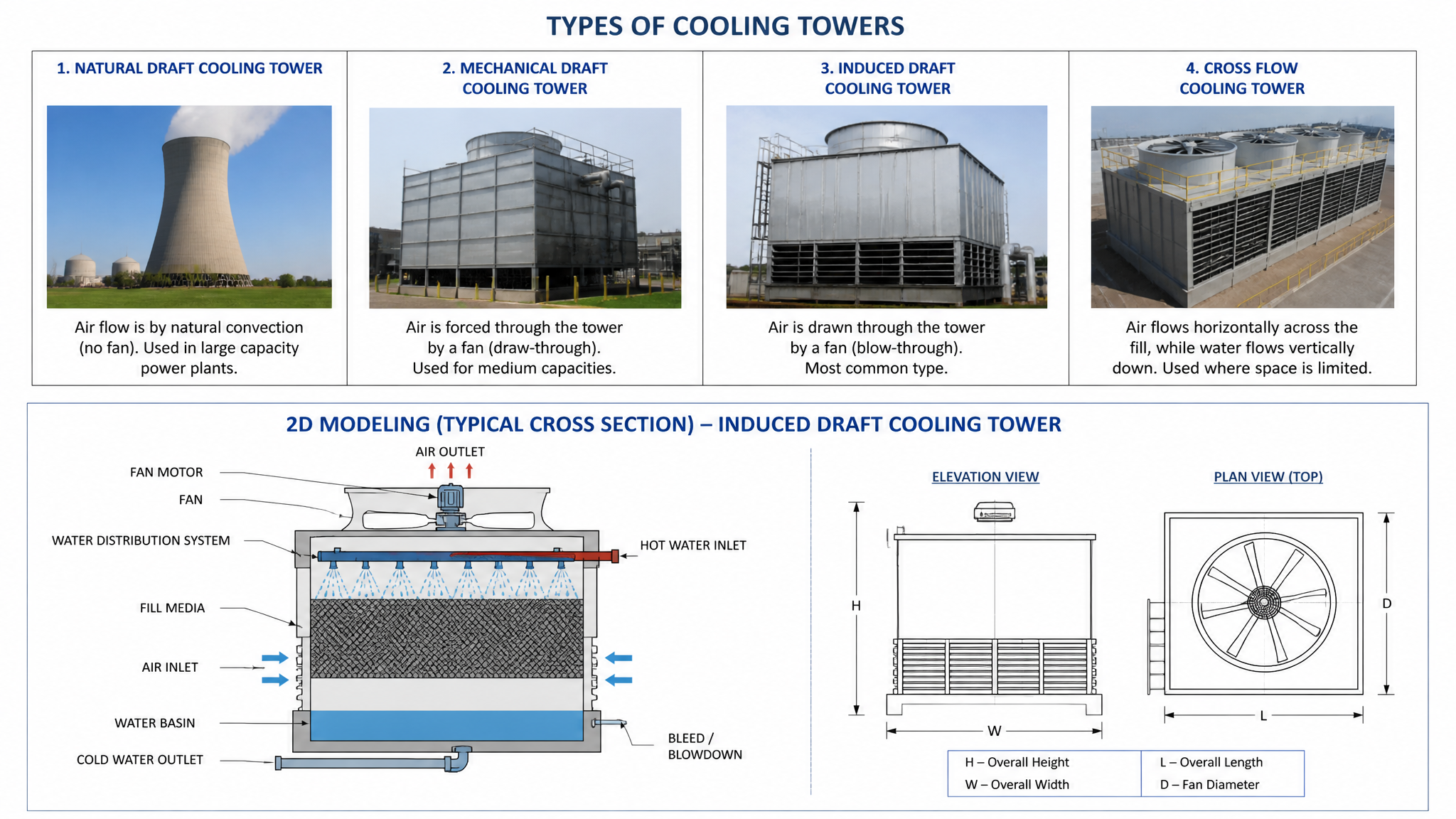
By airflow mechanism, towers split into natural draft and mechanical draft. Natural draft towers are the enormous hyperbolic chimneys you see at large thermal power plants. They move air through sheer height and the density difference between warm, moist inside air and cooler outside air, with no fans at all. Mechanical draft towers use fans to push or pull air through the fill, giving you tighter control over performance regardless of weather. Most industrial and commercial sites use mechanical draft because it fits a smaller footprint and delivers predictable results.
By water and air flow direction, you choose counterflow or crossflow. In a counterflow tower, air moves vertically upward against water falling downward. In a crossflow tower, air moves horizontally across the falling water. Counterflow typically achieves a closer approach to the wet bulb temperature and keeps the water distribution system enclosed, which reduces algae growth and debris exposure.
| Classification axis | The three/two options | Best suited for |
|---|---|---|
| Material | FRP, RCC, Pultruded FRP | FRP for corrosive/compact sites; RCC for very large long-life plants; pultruded FRP for higher structural strength |
| Airflow | Natural draft, Mechanical draft | Natural draft for massive power-station loads; mechanical draft for controllable, compact industrial use |
| Flow direction | Counterflow, Crossflow | Counterflow for tighter approach and cleaner water path; crossflow for lower fan power and easier access |
If you want to see how these elements physically fit together, a labelled cooling tower diagram showing fill media, drift eliminators, distribution nozzles, fan, and basin makes the airflow and water paths much easier to visualise than any description can.

Why cooling towers are required in the first place
Every process that generates heat needs somewhere to send it. A heat exchanger, condenser, or compressor transfers unwanted heat into water, but that water then has to be cooled before it can be reused. Dumping hot water into a drain or a river is wasteful, often illegal, and expensive once you account for the fresh water you’d keep buying. A cooling tower recirculates the same water, rejecting heat through evaporation so you top up only a small amount lost to evaporation, drift, and blowdown.
The payoff is both operational and financial. Continuous recirculation means your condensers and compressors keep running at their designed temperatures, which protects efficiency and equipment life. Skip the tower and your chillers work harder, your product quality drifts, and your energy bill climbs.
Why cooling towers run thermal power plants
Thermal power generation is essentially a heat engine. You boil water into steam, spin a turbine with it, and then you must condense that steam back into water to close the cycle. Condensing demands rejecting an enormous quantity of waste heat, and that’s precisely the cooling tower’s job at a power station.
This is why you see those towering natural draft structures at large plants. The heat load is so immense that fans become impractical at that scale, so the plant uses the chimney effect of a tall hyperbolic shell to move millions of cubic metres of air. Smaller captive power plants, solar thermal setups, and industrial boilers often use mechanical draft RCC or FRP towers instead, because their loads fit comfortably within fan-driven designs. In every case, if the tower underperforms, the turbine back-pressure rises and generation efficiency drops, so reliability isn’t optional here.
How cooling towers keep data centers online
Data centers run thousands of servers that convert electricity into heat around the clock, and that heat has to go somewhere every second of every day. Many facilities use a chilled water loop to pull heat from server halls, and a cooling tower then rejects that heat to the atmosphere, often paired with a chiller.
What makes data center cooling distinctive is the intolerance for downtime. A cooling tower serving a data center is usually specified with redundancy, careful water treatment to prevent scaling and biological fouling, and drift eliminators that minimise water loss and plume. Many operators also run water-side economisation, using cooler ambient conditions to cool the loop directly through the tower and switching off the chiller when weather allows. Done well, that trims energy use significantly during cooler months.
Which cooling tower is more efficient
Efficiency isn’t a single number, so the honest answer is “it depends on what you’re optimising.” If you mean thermal efficiency, how closely the tower cools water toward the wet bulb temperature, counterflow designs generally edge out crossflow because the coldest water meets the driest, coolest air at the bottom. A tighter approach means colder water to your process, which almost always improves plant efficiency downstream.
If you mean energy efficiency, the picture broadens. Crossflow towers sometimes use lower fan power because air travels a shorter path through the fill. Fan selection, motor efficiency, fill media condition, and nozzle health all swing total energy consumption more than the tower category alone. A well-maintained tower with clean fill and correctly pointed nozzles will outperform a neglected one of a supposedly superior type.
Water efficiency deserves equal weight. Good drift eliminators cut water loss to a fraction of a percent of circulation, and sensible cycles of concentration reduce blowdown. On these fronts, a counterflow FRP tower with enclosed distribution tends to hold up well because the closed water path resists contamination and keeps the fill working as designed.
For most industrial and commercial applications, a mechanical draft counterflow tower delivers the best balance of close approach, compact footprint, and controllable performance. Mihir Cooling Towers builds its FRP, RCC, and pultruded FRP ranges on counterflow technology for exactly this reason, across series suited to loads from compact HVAC duties up to heavy process plants.
Frequently Asked Questions
Is FRP or RCC the better cooling tower material?
Neither is universally better; they suit different jobs. FRP resists corrosion naturally and installs quickly in a compact footprint, which suits chemical, textile, pharma, and coastal sites. RCC is built for very large, multi-decade installations like power stations where the civil structure itself anchors the plant. Match the material to your heat load, site life, and water chemistry rather than defaulting to one.
What is the difference between counterflow and crossflow cooling towers?
In counterflow towers, air rises vertically against water falling downward, giving a closer approach to wet bulb temperature and an enclosed water path that resists algae and debris. In crossflow towers, air moves horizontally across the falling water, which can lower fan power and ease maintenance access. Counterflow generally wins on thermal performance and water cleanliness.
How much water does a cooling tower actually lose?
Water leaves through evaporation, drift, and blowdown. Evaporation is unavoidable and does the cooling work. Drift, water carried out as fine droplets, is kept to a small fraction of circulation by quality drift eliminators. Blowdown is controlled by managing cycles of concentration. Together, make-up water is a modest percentage of your total circulation when the tower is maintained well.
The three-type framing is less about picking a single winner and more about understanding which axis your project is sensitive to. Corrosive water pushes you toward FRP. Massive power loads point to natural draft. A tight temperature target favours counterflow. Map your heat load, footprint, water quality, and maintenance capacity against those axes, and the right configuration tends to reveal itself. If you’re weighing options for a new installation or a capacity upgrade, our team can help size the tower to your actual range, approach, and wet bulb conditions rather than a generic rule of thumb.