

Key Takeaways
- Cooling towers split into two main families by draft (natural and mechanical) and by airflow path (counterflow and crossflow), and the right pick depends on your heat load, footprint and water quality.
- FRP, RCC and pultruded FRP construction each suit different lifespans, corrosion risks and capacities, so the shell material is as important a decision as the airflow design.
- Switching to non-potable or recycled makeup water cuts freshwater draw but demands tighter water treatment to control scaling, fouling and biological growth.
- Energy efficiency gains usually come from fan upgrades, clean fill media, correct nozzle spray patterns and running towers closer to their design approach.
- A capable cooling tower manufacturer should help you match tower type to your process rather than selling a one-size-fits-all unit.
Pick the wrong cooling tower and you pay for it every single day, in higher pump energy, more makeup water, scale-choked fill and a process that never quite hits its target temperature. Understanding the types of cooling towers before you buy is the difference between a utility that quietly does its job for decades and one that becomes a recurring maintenance headache. This guide breaks down how towers are classified, how the common designs compare, and where water and energy savings actually come from.
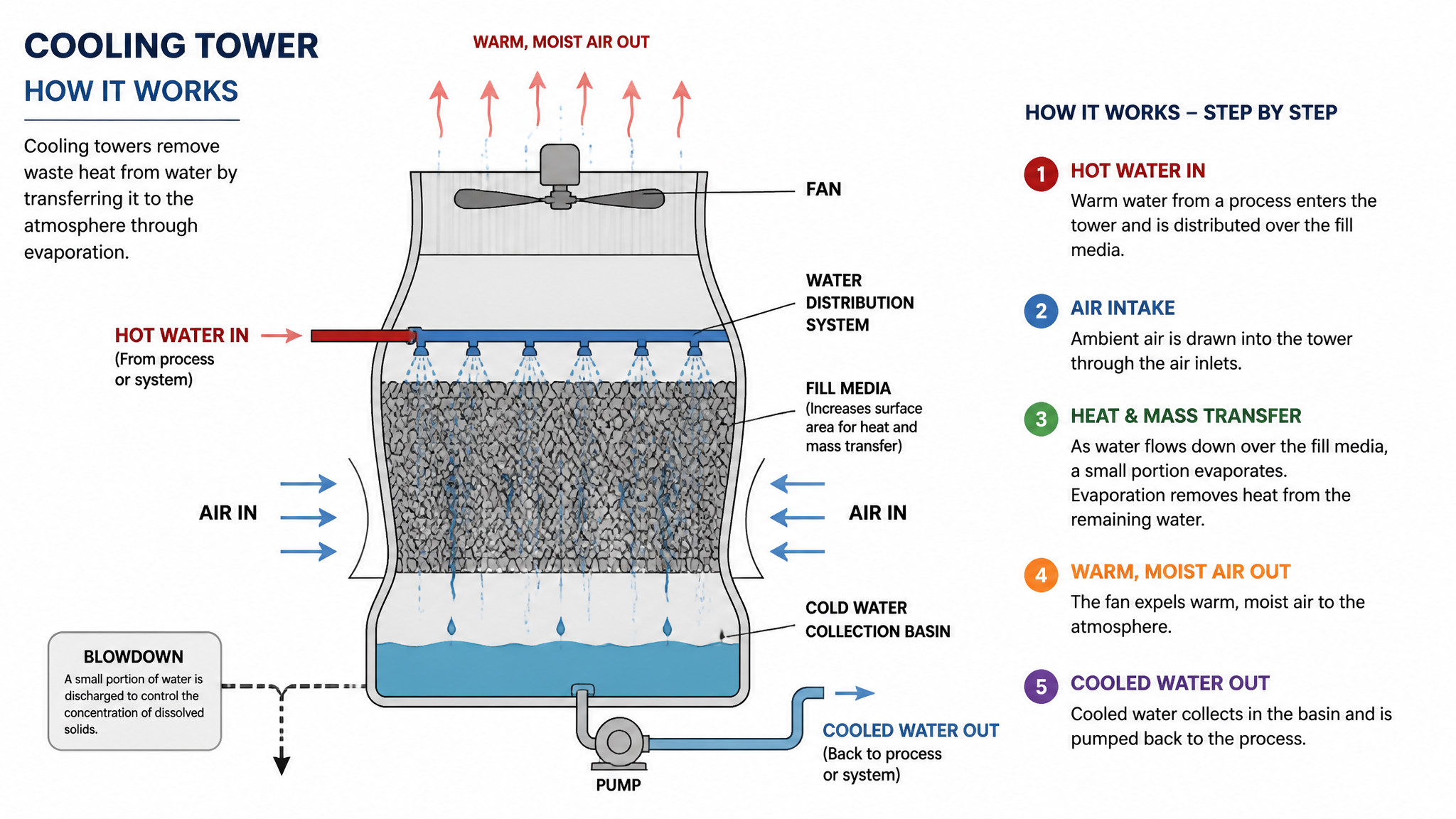
How the Types of Cooling Towers Are Classified
Cooling towers get grouped two ways, and both matter when you’re specifying a unit. The first is by how air moves through the tower. The second is by the direction that air travels relative to the falling water.
By draft, you have natural draft and mechanical draft. Natural draft towers are the enormous hyperbolic concrete structures you see at thermal power stations. They rely on the chimney effect of a tall shell to pull air through, with no fans at all. They make sense only at very large heat loads where the sheer scale justifies the civil cost. For almost every process plant, textile unit, chemical facility or commercial building, mechanical draft is the practical choice. Here fans move the air, and you get two sub-types: induced draft, where the fan sits at the top and pulls air up through the tower, and forced draft, where the fan sits at the base and pushes air in.
The second classification is airflow path. In a counterflow tower, air moves straight up while water falls straight down, so the two run in opposite directions. In a crossflow tower, air moves horizontally across the water as it falls. Counterflow designs generally give better thermal performance per unit footprint and keep the water distribution system enclosed, which reduces algae growth and debris exposure. Crossflow towers offer easier access to internal components and lower pumping head, but they take up more plan area for the same duty.
Mihir Cooling Towers builds its range on counterflow technology across the PM, RCM, CM, RB, SM, FM, FRM and XE series, a design choice that favours compact footprint and consistent thermal contact between air and water.
Types of Cooling Towers Used in HVAC and Process Plants
Walk into a hospital plant room or a large commercial complex and the cooling tower feeding the chiller plant is almost always a mechanical draft, induced draft unit. HVAC loads are steady and the water quality is reasonably controlled, so a compact FRP tower handles the duty well without a huge civil footprint. The priority here is quiet operation, low drift and a clean plan area on the terrace or plant yard.
Process industries ask more from the tower. A cement, sugar or petrochemical plant runs higher heat loads, dirtier circulating water and far longer operating hours. That changes the calculus toward either a larger pultruded FRP tower or a reinforced concrete (RCC) structure built to last decades under heavy, continuous duty. An industrial cooling tower in these settings is sized around real process data: the heat load in kcal/hr, the range (the temperature drop you need across the tower), the approach (how close you can get to the ambient wet bulb), and the design wet bulb temperature for your location. Get any of those wrong and the tower underperforms no matter how well it’s built.
The shell material deserves its own decision. The table below sets out how the three common construction types compare for an industrial setting.
| Construction type | Best suited for | Key strengths | Watch-outs |
|---|---|---|---|
| FRP (moulded panels) | Small to medium loads, HVAC, light industry | Corrosion-proof, light, quick to install, low maintenance | Panel joints and structure can limit very large capacities |
| Pultruded FRP | Medium to large industrial loads | High structural strength, corrosion-proof, good for continuous duty | Higher initial cost than moulded FRP |
| RCC (concrete) | Very large, long-life installations | Extremely durable, fire-resistant, handles massive flows | High civil cost, long build time, heavy foundation needs |
Mihir Cooling Towers manufactures all three, FRP, RCC and pultruded FRP, and runs an in-house pultrusion facility, which matters when you want structural sections matched to a specific load rather than off-the-shelf profiles.
Comparing Cooling Tower Types Without Overcomplicating It
The comparison that trips most buyers up isn’t FRP versus RCC. It’s counterflow versus crossflow and induced versus forced draft, because those choices affect running cost every hour the tower operates.
Induced draft pulls air through after it has passed the fill, so the fan handles saturated, warmer air. The upside is more uniform airflow across the fill and better resistance to recirculation, where hot discharge air gets sucked back into the inlet. Forced draft puts the fan on the cold dry air side, which can be mechanically simpler to service, but these units are more prone to recirculation and icing in cold climates. For most Indian industrial conditions, induced draft counterflow is the workhorse.
Here’s the honest trade-off: a crossflow tower with gravity water distribution runs at lower pump pressure, so if your pumping energy is a big slice of the bill, it can win on total cost even though the tower itself is larger. A counterflow tower claws that back with a smaller footprint and better fouling resistance. There’s no universally correct answer. The right pick depends on your available space, your water quality and how much you pay for electricity versus land.
Water Use, Recycled Water and Efficiency Considerations
A cooling tower loses water three ways: evaporation (the part that actually does the cooling), drift (fine droplets carried out in the air stream), and blowdown (water deliberately dumped to stop dissolved solids concentrating). Evaporation is unavoidable physics. Drift and blowdown are where you save.
Good drift eliminators cut droplet loss to a fraction of the circulating flow, which protects both water and the surrounding area from the white plume and mineral deposits. Blowdown is governed by cycles of concentration: run more cycles and you waste less water, but you also let dissolved solids climb, which raises scaling and corrosion risk. The sweet spot depends entirely on your makeup water chemistry.
Many plants now feed their towers with non-potable or recycled water, treated sewage effluent, RO reject, or process water, to cut freshwater draw. This is sound practice, but it shifts the burden onto water treatment. Recycled streams often carry higher hardness, chlorides, phosphates or organic load, all of which accelerate scaling, under-deposit corrosion and biological fouling in the fill media. If you’re going this route, budget for a proper treatment program: controlled dosing, biocide rotation, and regular monitoring of conductivity and pH. The tower will handle recycled water happily as long as the chemistry stays inside the envelope it was designed for. Skip the treatment and you’ll be replacing fill and cleaning distribution nozzles far too often.
Ways to Improve Cooling Tower Energy Efficiency
Energy efficiency rarely comes from one big fix. It comes from several small ones that compound.
- Keep the fill clean and intact. Scaled or collapsed fill media wrecks air-water contact, so the fan works harder for less cooling and your approach widens. Clean fill is the cheapest efficiency upgrade most plants ignore.
- Check nozzle spray patterns. Clogged or worn nozzles create dry patches on the fill where no cooling happens, and that dead zone drags down the whole tower’s performance even though the pump is running at full flow.
- Match the fan to the real duty. Oversized fans running flat out burn energy they don’t need. A correctly selected fan, or a variable frequency drive that trims fan speed as the load drops, cuts power draw sharply during part-load hours.
- Run closer to the design approach, not tighter. Chasing a colder outlet than the tower was built for forces every component to overwork for diminishing returns, so size the tower for the approach your process genuinely needs.
- Control recirculation and fouling at the inlet. Debris screens, correct tower orientation and adequate spacing from walls keep inlet air cool and clean, which directly improves thermal output per unit of fan energy.
The pattern across all of these is the same: efficiency lives in maintenance and correct selection, not in exotic hardware. A tower that’s clean, correctly sized and running at its design point will almost always beat a neglected premium unit.
Why Choosing the Right Cooling Tower Manufacturer Decides the Outcome
The construction material and airflow design only deliver if the tower is correctly sized and built for your process. That’s where the cooling tower manufacturer earns its place. A good one asks about your heat load, range, approach, local wet bulb and water chemistry before recommending anything, and pushes back if you’re over- or under-specifying. A weaker supplier simply sells you a model number.
Mihir Cooling Towers has manufactured FRP, RCC and pultruded FRP towers since 1976, with an in-house pultrusion facility and after-sales service across industries from cement, chemical and petrochemical to textile, sugar, power, pharma, hospitals and HVAC. That spread matters because each industry stresses the tower differently, and a manufacturer that has seen those variations can steer you toward the type that actually fits rather than the one that’s easiest to ship.
Frequently Asked Questions
What is the main difference between counterflow and crossflow cooling towers?
In a counterflow tower, air travels straight up while water falls straight down, giving strong thermal contact in a compact footprint and an enclosed water distribution system that resists algae. In a crossflow tower, air moves horizontally across the falling water, which lowers pump pressure and improves access to internal parts but needs more plan area for the same cooling duty.
Can I run a cooling tower on recycled or non-potable water?
Yes, many industrial plants feed towers with treated effluent, RO reject or process water to reduce freshwater use. The key is a solid water treatment program, because recycled streams usually carry higher hardness, chlorides and organic load that accelerate scaling, corrosion and biological fouling if left uncontrolled.
Which cooling tower construction lasts the longest?
RCC concrete towers generally offer the longest service life and suit very large, continuous-duty installations, while pultruded FRP gives excellent corrosion resistance and strength for medium to large loads. Moulded FRP is ideal for smaller HVAC and light industrial duties where quick installation and low maintenance matter most.
How do I size a cooling tower correctly?
Sizing depends on four process figures: the heat load you need to reject, the range or temperature drop across the tower, the approach to local wet bulb temperature, and your site’s design wet bulb. Share accurate data for all four with your manufacturer, since guessing any of them leads to a tower that either underperforms or wastes energy and capital.
The simplest way to avoid a costly mismatch is to start from your process data and let the tower type follow from it, not the other way round. If you know your heat load, range, approach and water quality, a capable manufacturer can tell you quickly whether FRP, pultruded FRP or RCC, and counterflow or crossflow, is the right call for your plant.