
Key Takeaways
- Cooling towers remove process heat by evaporating a small fraction of the circulating water, keeping equipment and plant spaces within safe operating temperatures.
- Choose the right industrial cooling towers, FRP, RCC, or pultruded FRP, depending on your heat load, water quality, footprint, and how corrosive your environment is.
- Counterflow design, good fill media, and proper drift eliminators directly affect how efficiently a tower cools and how much water it wastes.
- Correct sizing around range, approach, and wet bulb temperature matters more than raw tonnage when you want consistent cooling.
- A manufacturer with in-house pultrusion and after-sales support, like Mihir Cooling Towers, shortens both installation and long-term maintenance headaches.
Walk into any busy process plant and you’ll feel it before you see it: heat. Furnaces, compressors, condensers, injection moulding machines, and reactors all throw off enormous amounts of thermal energy. Left unchecked, that heat damages equipment, slows production, and makes the working environment miserable. This is exactly where cooling towers earn their keep. They pull heat out of your process water and reject it to the atmosphere, keeping machinery and plant areas cool enough to run around the clock.
Understanding how a cooling tower actually makes industrial spaces cooler, and how to choose one that fits your plant, is the difference between stable production and constant firefighting. Let’s break down how these systems work, where they fit, and what separates a well-built tower from one that becomes a recurring headache.
How a Cooling Tower Turns Hot Process Water Into Cool Plant Conditions
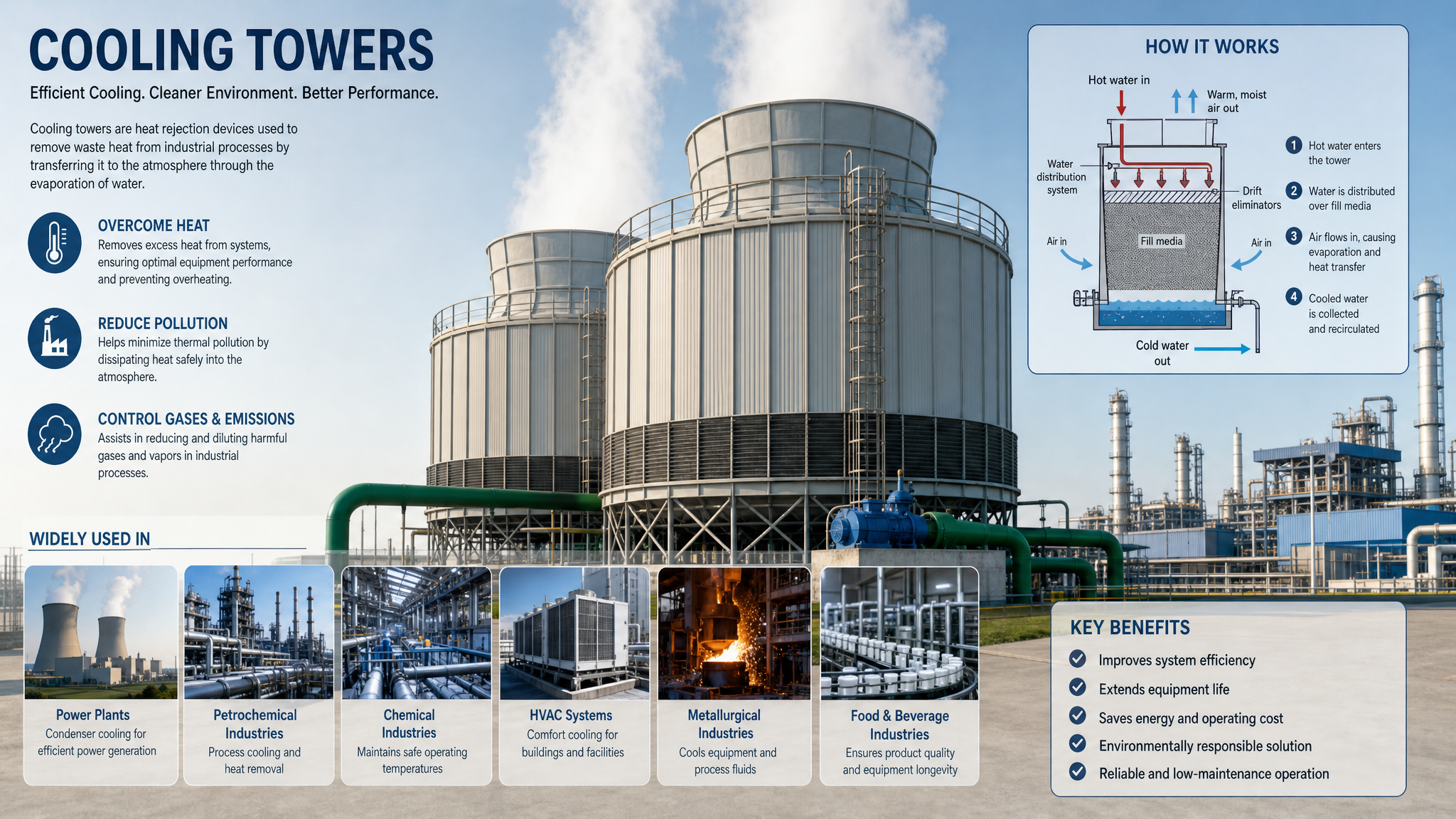
The core idea is simpler than most people assume. Hot water from your process, think condenser outlets, jacketed vessels, or machine cooling circuits, gets pumped to the top of the tower and sprayed over fill media. As that water trickles down through the fill, air moves across it. A small portion of the water evaporates, and evaporation carries away heat. The water that collects in the basin below comes out several degrees cooler, ready to loop back into your process.
That evaporative principle is why a cooling tower can drop water temperature below what a simple air-cooled radiator ever could. You’re not just blowing air over hot metal. You’re using the physics of phase change, which is far more effective at shedding heat.
In a counterflow tower, water falls downward while air is drawn upward against it. This arrangement gives the most thermal contact between air and water, which is why it tends to deliver better cooling in a compact footprint. Mihir Cooling Towers builds its range on counterflow technology for this reason, across FRP, RCC, and pultruded FRP designs.
The cooling effect doesn’t stay inside the tower. When your condensers, chillers, and machines receive consistently cool water, they run at lower temperatures, reject heat more efficiently, and stop radiating excess heat into the shop floor. Cooler equipment means a cooler working space, fewer heat-related trips, and less strain on your HVAC load.
Where Cooling Towers Make the Biggest Difference Across Industries
No two plants shed heat the same way, which is why cooling tower selection is rarely one-size-fits-all. A sugar mill dealing with evaporators and crystallisers has a very different cooling profile from a pharmaceutical facility running tight temperature control on reactors.
- Power and steel plants push heavy, continuous heat loads through condensers and quenching systems, so they typically need towers sized for high flow rates and sustained duty, often with RCC construction for very large capacities.
- Chemical and petrochemical units deal with aggressive water chemistry and corrosive atmospheres, which makes FRP or pultruded FRP structures a practical choice because they resist corrosion far better than mild steel.
- Textile, dairy, and food plants care about hygiene and steady temperatures, so fill media selection and clean basin design matter as much as raw cooling capacity.
- Plastic and injection moulding shops rely on tight mould temperatures, and even a few degrees of variation in cooling water can affect cycle times and part quality.
- HVAC and commercial cooling in hospitals, hotels, and large buildings uses towers to reject heat from chillers, keeping air conditioning efficient during peak summer loads.
Across every one of these, the tower is doing the same fundamental job, pulling heat out of the loop, but the construction, materials, and sizing shift with the application.
Why Manufacturers of Cooling Towers Matter More Than You Think
It’s tempting to treat a cooling tower as a commodity: pick a tonnage, place an order, move on. In practice, the quality of the manufacturer shapes how well your plant stays cool for the next fifteen or twenty years. This is where the role of established manufacturers of cooling towers becomes clear, because the details they get right are the ones that quietly determine your running costs.
Consider what actually goes into a good tower. The fill media has to be the right type and depth for your water quality; the wrong fill clogs with scale in dirty water and cripples cooling. Drift eliminators need to be designed to catch water droplets before they escape, or you lose treated water and create a wet, corrosive zone around the tower. Fan selection and blade pitch govern airflow and, by extension, how much electricity you burn to move air. Nozzle design decides whether water spreads evenly over the fill or channels down a few paths and wastes capacity.
A manufacturer who controls these elements in-house can match them to your real operating conditions instead of selling a generic box. Mihir Cooling Towers, for example, runs its own pultrusion facility, which gives it direct control over the structural FRP members that form the tower frame. That matters in corrosive plant environments where a poorly made structure rots out years before the fill or fans do.
Choosing the Right Tower Type: FRP, RCC, or Pultruded FRP
Material choice is one of the first real decisions, and it comes down to capacity, environment, and lifespan expectations.
| Tower Type | Best Suited For | Key Strengths | Watch-Outs |
|---|---|---|---|
| FRP (Fibre Reinforced Plastic) | Small to medium loads, corrosive atmospheres | Corrosion resistant, light, quick to install, low maintenance | Capacity limits compared to RCC for very large duties |
| RCC (Reinforced Cement Concrete) | Very large, continuous-duty plants | High structural strength, long service life, handles huge flows | Heavier civil work, longer build time, higher upfront cost |
| Pultruded FRP | Medium to large loads needing strength plus corrosion resistance | Stronger, more uniform structural members than hand-layup FRP | Depends on manufacturer having real pultrusion capability |
For a chemical plant with corrosive makeup water and a moderate load, FRP or pultruded FRP usually wins because it shrugs off corrosion that would eat a concrete or steel structure. For a large thermal power station, RCC often makes sense because the sheer flow and continuous duty justify the heavier construction. There’s no universally “best” material, only the one that fits your conditions, and a manufacturer offering all three can give you honest guidance instead of pushing whatever they happen to make.
Sizing and Selection: The Numbers That Decide Real Cooling
A tower rated at a big tonnage number can still fail to cool your plant if it was selected on the wrong parameters. Three figures do most of the work here.
Range is the temperature difference between the hot water entering the tower and the cool water leaving it. A larger range means the tower is pulling out more heat per pass.
Approach is how close the cooled water gets to the ambient wet bulb temperature. A tight approach, say a few degrees above wet bulb, demands a larger or better-designed tower, because getting those last degrees out is the hardest part.
Wet bulb temperature is the realistic lower limit your tower can reach, set by local humidity and climate. This is why a tower sized for a dry inland site may struggle on a humid coastal one. Selecting around an unrealistically low wet bulb is one of the most common ways plants end up with towers that can’t hold temperature in peak season.
Get these three right, matched to your actual heat load, and the tower delivers stable cooling year-round. Get them wrong and you’re left topping up with additional cooling, chasing production slowdowns, and wondering why a brand-new tower isn’t performing.
What the Best Cooling Towers Manufacturers Get Right on Efficiency
Cooling is only half the story. The other half is how much water and power the tower costs you every single day. The best cooling towers manufacturers treat efficiency as a design goal, not an afterthought, and it shows in a few specific areas.
Water loss is the first. Every tower loses some water to evaporation, which is unavoidable and actually does the cooling. But poor drift eliminators let whole droplets blow away, and poor basin or valve design leads to excess bleed-off. Well-designed drift eliminators and controlled blowdown keep your makeup water, and your water treatment chemical bill, in check.
Energy comes next. Fans are the biggest electrical draw on a tower. Efficient fan and motor selection, correct blade pitch, and a design that gets good airflow without oversizing the fan all reduce the power you spend to move air. Over a year of continuous running, that difference is substantial.
Then there’s maintainability. Scaling and fouling slowly choke a tower’s performance, so fill media that resists clogging, accessible components for cleaning, and a layout that lets your team inspect and service without a shutdown all protect your cooling capacity over time. A manufacturer that also provides after-sales service, as Mihir Cooling Towers does, closes the loop by helping you keep the tower performing years after commissioning, rather than leaving you to sort out problems alone.
Retrofits and Upgrades: Cooling More Without Rebuilding
Plants grow. A tower sized correctly at commissioning can fall behind when you add a production line or push existing equipment harder. Ripping out the whole system is rarely the first answer.
Often you can recover or add capacity by replacing degraded fill media, upgrading drift eliminators, swapping to a more efficient fan, or reworking the water distribution system. If the structure is sound, these targeted upgrades can lift performance meaningfully at a fraction of the cost and downtime of a new tower. When the load has genuinely outgrown the structure, a capacity upgrade or additional cell becomes the sensible move. A manufacturer who inspects your existing setup honestly will tell you which path fits, instead of defaulting to a full replacement.
Frequently Asked Questions
How much does a cooling tower actually cool the water?
It depends on the design and local conditions, but the key figure is the approach: how close the cooled water gets to the ambient wet bulb temperature. A well-selected tower can bring water to within a few degrees of wet bulb, which is often significantly cooler than the hot water entering it. The exact drop depends on your range, flow rate, and climate.
Is FRP or RCC better for an industrial cooling tower?
Neither is universally better. FRP and pultruded FRP suit corrosive environments and small to medium loads because they resist corrosion and install quickly. RCC suits very large, continuous-duty plants where high structural strength and massive flow rates justify the heavier civil work. Your water chemistry, load size, and footprint decide the right choice.
Why does my cooling tower lose water, and is that normal?
Some water loss is normal and necessary, because evaporation is what removes the heat. Problems arise when poor drift eliminators let whole droplets escape or when blowdown is poorly controlled. Good eliminator design and managed bleed-off keep makeup water and treatment costs reasonable while still cooling effectively.
Can I increase cooling capacity without buying a whole new tower?
Frequently, yes. Replacing worn fill media, upgrading drift eliminators, fitting a more efficient fan, or improving water distribution can recover or add capacity if the structure is sound. A full replacement or additional cell only becomes necessary when the load has truly outgrown the existing structure.
A cooling tower doesn’t just cool water, it keeps your entire plant within the temperature band where equipment runs reliably and people can work. The towers that do this best aren’t the cheapest on paper; they’re the ones matched carefully to your heat load, water quality, and climate, then supported well after installation. If you’re planning a new system, replacing an aging one, or trying to squeeze more out of what you have, start by getting your range, approach, and wet bulb numbers straight, then talk to a manufacturer who builds across FRP, RCC, and pultruded FRP and can point you to the right fit rather than the easy sell.