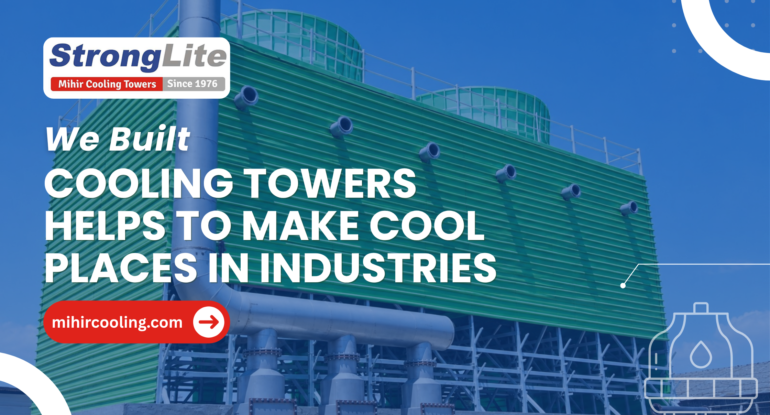
Key Takeaways Cooling towers remove process heat by evaporating a small fraction of the circulating water, keeping equipment and plant spaces within safe operating temperatures. Choose the right industrial cooling towers, FRP, RCC, or pultruded FRP, depending on your heat load, water quality, footprint, and how corrosive your environment is. Counterflow design, good fill media, and proper drift eliminators directly affect how efficiently a tower cools and how much water it wastes. Correct sizing around range, approach, and wet bulb temperature matters more than raw tonnage when you want consistent cooling. A manufacturer with in-house pultrusion and after-sales support, like Mihir Cooling Towers, shortens both installation and long-term maintenance headaches. Walk into any busy process plant and you’ll feel it before you see it: heat. Furnaces, compressors, condensers, injection moulding machines, and reactors all throw off enormous amounts of thermal energy. Left unchecked, that heat damages equipment, slows production, and makes the working environment miserable. This is exactly where cooling towers earn their keep. They pull heat out of your process water and reject it to the atmosphere, keeping machinery and plant areas cool enough to run around the clock. Understanding how a cooling tower actually makes industrial spaces cooler, and how to choose one that fits your plant, is the difference between stable production and constant firefighting. Let’s break down how these systems work, where they fit, and what separates a well-built tower from one that becomes a recurring headache. How a Cooling Tower Turns Hot Process Water Into Cool Plant Conditions The core idea is simpler than most people assume. Hot water from your process, think condenser outlets, jacketed vessels, or machine cooling circuits, gets pumped to the top of the tower and sprayed over fill media. As that water trickles down through the fill, air moves across it. A small portion of the water evaporates, and evaporation carries away heat. The water that collects in the basin below comes out several degrees cooler, ready to loop back into your process. That evaporative principle is why a cooling tower can drop water temperature below what a simple air-cooled radiator ever could. You’re not just blowing air over hot metal. You’re using the physics of phase change, which is far more effective at shedding heat. In a counterflow tower, water falls downward while air is drawn upward against it. This arrangement gives the most thermal contact between air and water, which is why it tends to deliver better cooling in a compact footprint. Mihir Cooling Towers builds its range on counterflow technology for this reason, across FRP, RCC, and pultruded FRP designs. The cooling effect doesn’t stay inside the tower. When your condensers, chillers, and machines receive consistently cool water, they run at lower temperatures, reject heat more efficiently, and stop radiating excess heat into the shop floor. Cooler equipment means a cooler working space, fewer heat-related trips, and less strain on your HVAC load. Where Cooling Towers Make the Biggest Difference Across Industries No two plants shed heat the same way, which is why cooling tower selection is rarely one-size-fits-all. A sugar mill dealing with evaporators and crystallisers has a very different cooling profile from a pharmaceutical facility running tight temperature control on reactors. Power and steel plants push heavy, continuous heat loads through condensers and quenching systems, so they typically need towers sized for high flow rates and sustained duty, often with RCC construction for very large capacities. Chemical and petrochemical units deal with aggressive water chemistry and corrosive atmospheres, which makes FRP or pultruded FRP structures a practical choice because they resist corrosion far better than mild steel. Textile, dairy, and food plants care about hygiene and steady temperatures, so fill media selection and clean basin design matter as much as raw cooling capacity. Plastic and injection moulding shops rely on tight mould temperatures, and even a few degrees of variation in cooling water can affect cycle times and part quality. HVAC and commercial cooling in hospitals, hotels, and large buildings uses towers to reject heat from chillers, keeping air conditioning efficient during peak summer loads. Across every one of these, the tower is doing the same fundamental job, pulling heat out of the loop, but the construction, materials, and sizing shift with the application. Why Manufacturers of Cooling Towers Matter More Than You Think It’s tempting to treat a cooling tower as a commodity: pick a tonnage, place an order, move on. In practice, the quality of the manufacturer shapes how well your plant stays cool for the next fifteen or twenty years. This is where the role of established manufacturers of cooling towers becomes clear, because the details they get right are the ones that quietly determine your running costs. Consider what actually goes into a good tower. The fill media has to be the right type and depth for your water quality; the wrong fill clogs with scale in dirty water and cripples cooling. Drift eliminators need to be designed to catch water droplets before they escape, or you lose treated water and create a wet, corrosive zone around the tower. Fan selection and blade pitch govern airflow and, by extension, how much electricity you burn to move air. Nozzle design decides whether water spreads evenly over the fill or channels down a few paths and wastes capacity. A manufacturer who controls these elements in-house can match them to your real operating conditions instead of selling a generic box. Mihir Cooling Towers, for example, runs its own pultrusion facility, which gives it direct control over the structural FRP members that form the tower frame. That matters in corrosive plant environments where a poorly made structure rots out years before the fill or fans do. Pro Tip: Before you compare quotes, ask each vendor for the range, approach, and wet bulb temperature their offered tower is designed around. A cheaper tower quoted on an optimistic wet bulb will underperform the moment summer arrives, and that gap shows up as hot process water exactly