
Key Takeaways: Choose Best Cooling Towers
- There is no single best cooling tower; the right choice depends on your heat load, water quality, space, and industry conditions.
- FRP, RCC, and pultruded FRP towers each suit different duty cycles, corrosion risks, and plant lifespans.
- Counterflow and crossflow designs trade off footprint, maintenance access, and thermal performance differently.
- Sizing around range, approach, and local wet bulb temperature matters more than brand reputation alone.
- Matching the tower to your actual operating reality is what prevents oversized bills and premature failures.
Ask ten engineers which cooling tower is best, and you’ll get ten answers, most of them correct for their own plant and wrong for yours. The honest reply is that the best cooling tower is the one matched to your heat load, water chemistry, available space, and how hard you run it. A tower that performs beautifully in a pharma cleanroom utility block may corrode and underperform on a chemical site within a few seasons. So before comparing materials or series names, it helps to get clear on what a cooling tower actually does and where the real decisions lie.
What a Cooling Tower Actually Does, and Why It Shapes Your Choice
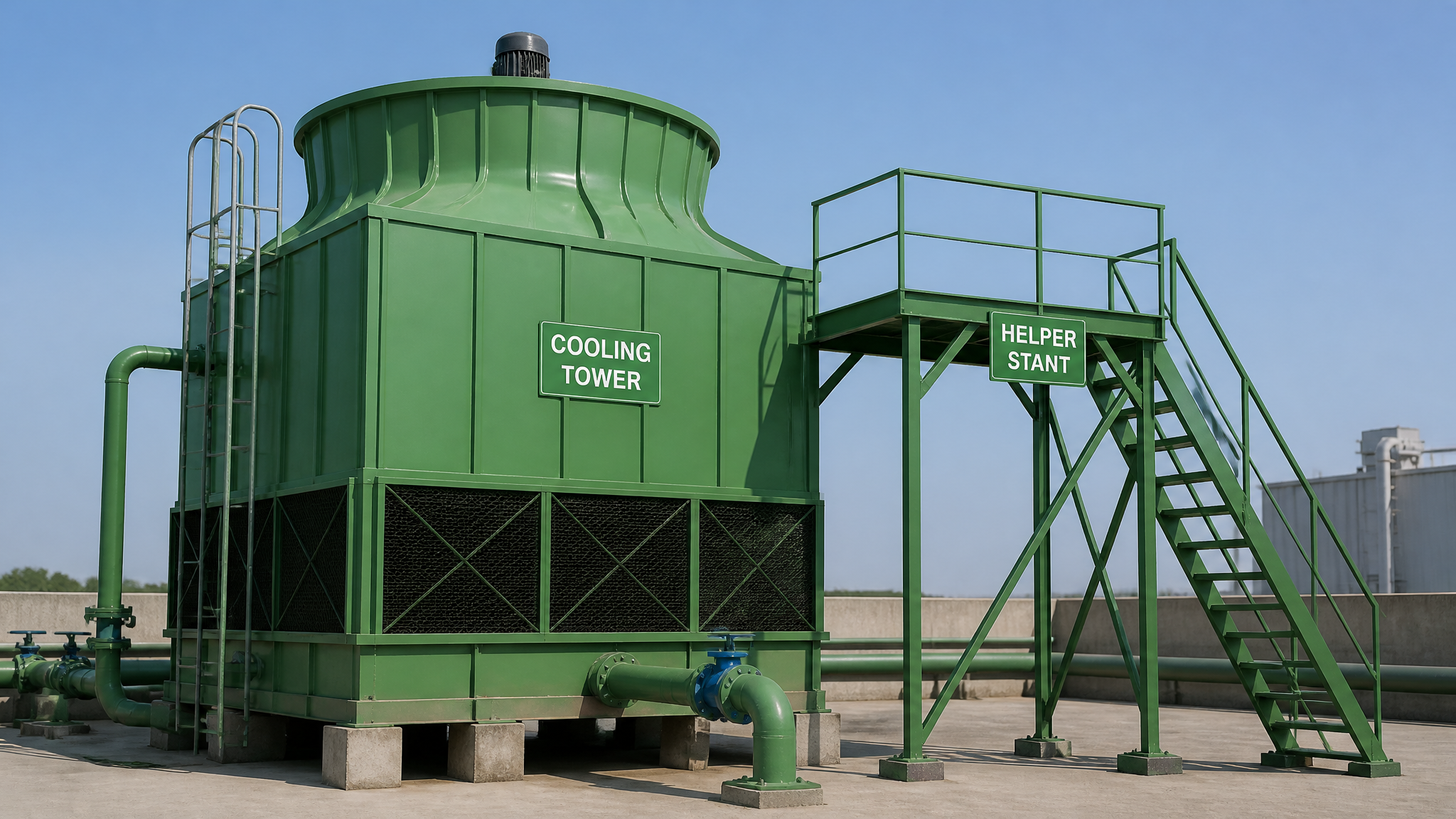
A cooling tower rejects waste heat from process water into the atmosphere through evaporation. Warm water from your process or condenser is pumped to the top of the tower, distributed over fill media, and broken into droplets or thin films. As air moves through, a small fraction of that water evaporates, and evaporation pulls heat out of the water that remains. The cooled water collects in the basin and returns to the plant.
That evaporative mechanism is why wet bulb temperature, not dry bulb, sets the limit on how cold your water can get. It’s also why water quality and drift matter so much. Understanding this helps you see why there’s no universal “best” tower. A dairy plant running clean water at a steady load has very different needs from a steel plant pushing dirty, high-temperature water around the clock.
In HVAC and commercial buildings, the same principle applies but the stakes shift. A cooling tower in HVAC systems typically rejects heat from a chiller’s condenser loop rather than a dirty process stream. The water tends to be cleaner, the loads swing with occupancy and weather, and quiet operation near occupied spaces becomes a design priority. That’s a different optimisation problem from a sugar mill, even though the physics is identical.
People sometimes confuse the tower with an HVAC heat exchanger. They’re related but distinct. A heat exchanger transfers heat between two fluids without evaporation, a plate heat exchanger or a shell-and-tube condenser, for example. The cooling tower is what ultimately dumps that collected heat to the air. In a chilled water plant, the chiller’s condenser is the heat exchanger, and the tower is the final heat rejection stage.
The Three Material Choices That Decide Most of the Outcome
Once you understand the duty, material is usually the first fork in the road. Most industrial decisions come down to FRP, RCC, or pultruded FRP construction.
FRP (fibre reinforced plastic) towers are corrosion resistant, lightweight, and quick to install. They suit most small to mid-size loads and chemically aggressive environments where steel or concrete would degrade. For many chemical, textile, pharma, and general manufacturing sites, an FRP tower hits the right balance of cost, lifespan, and resistance to the water chemistry being circulated.
RCC (reinforced cement concrete) towers are the heavyweight option, built for very large flow rates and long service life where the plant isn’t moving for decades. Power plants, large cement works, and big steel facilities often lean this way because the structure handles enormous water volumes and withstands harsh operating conditions over a long horizon. The trade-off is higher upfront cost, longer construction time, and a fixed footprint you can’t relocate.
Pultruded FRP sits between the two in spirit. The structural members are made through pultrusion, a process that pulls resin-soaked fibres through a die to form consistent, high-strength profiles. The result is a frame with excellent corrosion resistance and structural reliability, well suited to demanding duty cycles and larger FRP installations. Having an in-house pultrusion facility, as at Mihir Cooling Towers, means these profiles can be produced to consistent spec rather than sourced unpredictably.
| Factor | FRP | RCC | Pultruded FRP |
|---|---|---|---|
| Best fit | Small to mid loads, corrosive water | Very large loads, permanent sites | Demanding duty, larger FRP needs |
| Corrosion resistance | High | Moderate, needs treatment | High |
| Install speed | Fast | Slow | Fast to moderate |
| Relocatable | Yes | No | Yes |
| Upfront cost | Lower | Higher | Mid |
Counterflow vs Crossflow, and Why the Airflow Path Matters
Material answers “what it’s built from.” Airflow answers “how it moves heat.” The two main configurations are counterflow and crossflow.
In a counterflow tower, air moves vertically upward against the falling water. This gives efficient heat transfer in a compact footprint and tends to protect the water distribution system from sunlight, which limits algae growth. Mihir Cooling Towers builds its range on counterflow technology across the PM, RCM, CM, RB, SM, FM, FRM and XE series, spanning small commercial units up to large industrial duties.
Crossflow towers run air horizontally across the falling water. They often allow easier access to the distribution basin for maintenance and can operate at lower pump heads. The trade-off is typically a larger footprint and more exposure of the water to light and debris. Neither is universally better. Counterflow usually wins on footprint and thermal efficiency per square metre, while crossflow can simplify certain maintenance routines.
For most cooling towers for industries with limited plot space and a need for tight thermal performance, counterflow is the practical default. But if your site has sprawl to spare and your maintenance team values open-basin access, crossflow deserves a look.
Why the Best Cooling Towers Are the Ones Sized Correctly
Here’s where many purchases go wrong. Teams fixate on brand or material and skip rigorous sizing, then wonder why their water never reaches target temperature or why energy bills climb. The best cooling towers on paper fail in practice when the numbers behind them are guessed rather than calculated.
Three parameters drive sizing:
- Range is the temperature drop you need across the tower, the difference between hot water in and cold water out, and it ties directly to your process heat load rather than to any tower’s rated brochure figure.
- Approach is how close the cold water temperature gets to the ambient wet bulb, and a tighter approach demands a physically larger tower, so chasing an unrealistic approach inflates cost with little practical gain.
- Wet bulb temperature is set by your local climate and humidity, and it establishes the theoretical floor for your cold water, which is why a tower sized for a coastal city behaves differently when installed inland.
Get these wrong and no material or configuration will save you. An undersized tower runs hot and strains downstream equipment. An oversized one wastes capital and energy on fans and pumps you never needed. This is the single biggest reason to involve experienced cooling towers manufacturers early, while the heat load and site conditions are still being defined, rather than after the civil work is poured.
Components That Quietly Decide Daily Performance
Two towers with identical headline specs can perform very differently depending on their internal components. Fill media is the heart of heat transfer; film fill gives high efficiency with clean water, while splash fill tolerates dirty or scaling-prone water better. Drift eliminators control how much water escapes as fine droplets, which matters for water loss, chemical carryover, and local nuisance. Fans and nozzles govern airflow uniformity and distribution; a poorly matched fan wastes energy, and clogged nozzles create dry patches that cut effective capacity.
When you evaluate a tower, look past the shell. A well-built FRP tower with the wrong fill for your water chemistry will foul fast. The components should be chosen for your specific water and load, not left as an afterthought.
Matching the Tower to Your Industry
Different sectors push cooling systems in different directions. A pharma or hospital plant prioritises reliability, clean operation, and controlled drift. Chemical and petrochemical sites prioritise corrosion resistance above almost everything, which pushes hard toward FRP or pultruded FRP. Power, steel, and large cement operations often justify RCC for sheer volume and longevity. Textile, sugar, dairy, plastic, and injection moulding plants usually land on FRP or pultruded FRP sized to their specific duty cycle.
This is why a manufacturer serving a wide spread of industries can be useful: the recommendation shifts with your context rather than defaulting to whatever product is easiest to sell. The right answer for a solar facility’s auxiliary cooling is rarely the right answer for a 24/7 steel line.
Frequently Asked Questions
Is FRP or RCC better for a cooling tower?
Neither is universally better. FRP suits small to mid loads and corrosive water with faster installation, while RCC suits very large flow rates and permanent sites where decades of service life justify the higher upfront cost and longer build time. Your heat load, site permanence, and water chemistry decide which fits.
What is the difference between a cooling tower and an HVAC heat exchanger?
A heat exchanger transfers heat between two fluids without evaporation, such as a chiller’s condenser. A cooling tower is the evaporative stage that rejects that collected heat to the atmosphere. In a chilled water plant they work together, the exchanger passes heat to the condenser loop and the tower releases it.
How do I know what size cooling tower I need?
Size it around three numbers: your required range, your target approach, and your local design wet bulb temperature. These come from your actual heat load and climate, not from a brochure rating. Working with an experienced manufacturer during the design stage avoids the common errors of oversizing or undersizing.
Is counterflow or crossflow more efficient?
Counterflow generally delivers better thermal efficiency in a smaller footprint and shields the water distribution from sunlight. Crossflow can simplify basin maintenance and run at lower pump heads but usually needs more space. The better choice depends on your available plot area and maintenance preferences.
So which cooling tower is best? The one that matches your heat load, water quality, space, and industry, sized against your real wet bulb and built from a material that survives your water chemistry. Decide the duty first, then the material, then the airflow configuration, and only then compare specific models. If you’re weighing options for a new installation, a retrofit, or a capacity upgrade, bring your heat load and site conditions into the conversation early and let the design follow from there.